
Table of content:
- Map Content to Where the Reader Actually Is
- Build Topic Clusters Around a Few Core Money Pages
- Build a Calendar You Can Actually Sustain
- One Piece of Content, Five Formats
- Let Email Carry Readers Who Aren't Ready Yet
- Measure the Right Numbers, Not Just Traffic
- The Strategy Mistakes That Quietly Stall Growth
- Turning One Article Into Five Pieces of Content
- How Topic Clusters Actually Work in Practice
- Matching Content Format to Buyer Intent, Not Just Funnel Stage
- Building a Calendar You Can Actually Sustain
- Frequently Asked Questions
- Related Guides
Most affiliate sites publish without a plan and call it a content strategy because there’s a schedule on a calendar somewhere. Real affiliate content strategy starts from the other direction: you decide which pages need to convert, then you build everything else around getting the right readers to those pages at the right point in their decision. Without that structure, you end up with fifty posts that all compete with each other for the same few keywords while entire stages of the buyer’s journey go completely unaddressed.
Map Content to Where the Reader Actually Is
Someone searching “what is a CRM” is months away from buying anything. Someone searching “Pipedrive vs HubSpot pricing” might convert this week. Treating both searches with the same type of content (or worse, sending both to the same review page) wastes the first reader’s patience and confuses the second reader’s intent. Build content for four distinct stages: awareness (broad educational content), consideration (guides comparing categories of solutions), comparison (specific head-to-head and best-of content), and decision (single-product reviews and direct calls to action).
The mistake almost every beginner makes is writing only decision-stage content because that’s where commissions live. Without awareness and consideration content feeding traffic into your funnel, your decision pages have nothing pulling readers toward them, and they sit there ranking for nobody.
Build Topic Clusters Around a Few Core Money Pages
Pick five to ten “pillar” topics that map directly to your best affiliate programs, then build a cluster of eight to fifteen supporting articles around each one, all linking back to that pillar. A pillar built around “best email marketing tools” might be supported by individual reviews, a beginner’s guide to email marketing, a deliverability explainer, and a few comparison posts, all funneling link equity and reader attention back to the page that actually drives commissions. Our affiliate keyword research guide shows how to find the specific supporting topics worth writing inside each cluster.
Build a Calendar You Can Actually Sustain
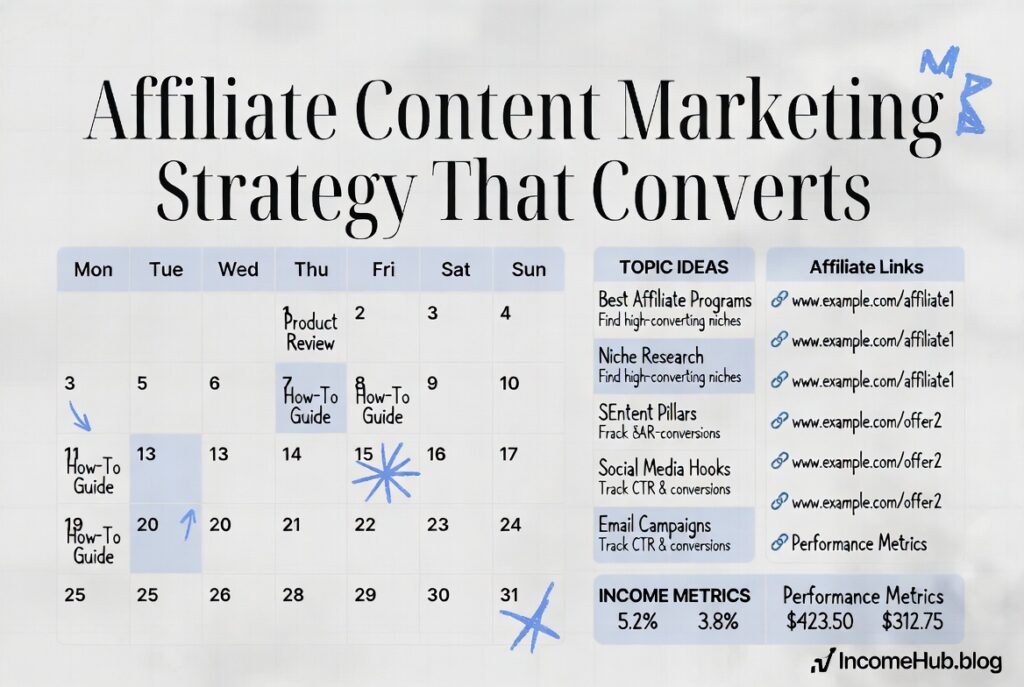
A content calendar that demands four posts a week from a solo affiliate marketer gets abandoned by week three. Plan around your real capacity, not your ambition. One well-researched, genuinely useful post a week, published consistently for a year, will outperform six rushed posts a week for two months followed by silence. Batch your research in one sitting, write in another, and edit in a third if that helps you keep moving without burning out on any single piece.
One Piece of Content, Five Formats
A single in-depth comparison article can become a YouTube video walking through the same comparison, a Pinterest pin summarizing the verdict, a short newsletter recapping the key takeaway with your affiliate link, and a handful of social posts pulling out specific stats or quotes. This isn’t about working harder, it’s about not wasting the research and thinking you already did on a single channel. Readers who’d never find your blog through search might find the YouTube version, and vice versa.
Let Email Carry Readers Who Aren’t Ready Yet
Most visitors to a comparison or review page aren’t ready to buy on that exact visit, and once they leave, you’ve usually lost them for good unless you’ve captured their email first. A simple lead magnet (a checklist, a cheat sheet, a discount code) tied to your highest-traffic content turns a one-time visitor into someone you can follow up with over the next few weeks, which meaningfully increases your overall conversion rate from the same traffic. Our guide to building affiliate email funnels that generate sales walks through this step by step.
Measure the Right Numbers, Not Just Traffic
Traffic feels good to watch climb, but it tells you almost nothing about whether your strategy is working financially. Earnings per click (EPC), the click-through rate on your affiliate links, and conversion rate by traffic source are the numbers that actually explain where your strategy is succeeding or quietly failing. A page with ten thousand monthly visitors and a 0.5 percent click-through rate is underperforming a page with five hundred visitors and a 4 percent click-through rate, even though the traffic chart for the first page looks far more impressive.
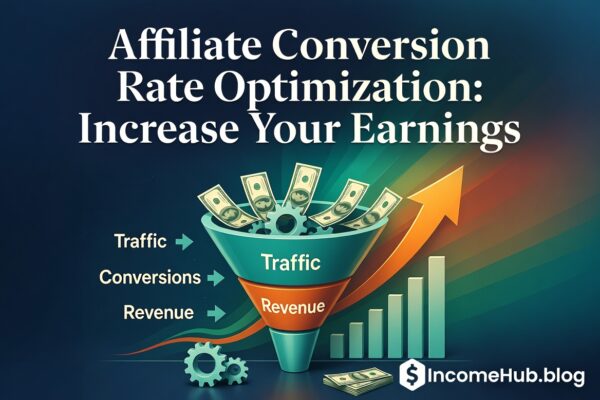
Once you’re tracking EPC and click-through rate consistently, small improvements in placement, copy, or trust signals on your existing pages will usually move your income faster than chasing more traffic. Our guide to affiliate conversion rate optimization covers exactly which changes tend to move these numbers the most.
The Strategy Mistakes That Quietly Stall Growth
Writing only about products you can earn the highest commission from, rather than products your specific audience actually needs, eventually erodes trust and tanks conversion rates even on the high-paying offers. Publishing comparison content that secretly favors whichever program pays you the most, rather than being honest about tradeoffs, gets noticed by readers faster than you’d expect and shows up in your bounce rate. And treating SEO and content strategy as two separate jobs, rather than one integrated plan, leads to beautifully written posts that nobody ever finds, because the keyword research and the content plan didn’t talk to each other.
Turning One Article Into Five Pieces of Content
Most affiliate creators treat each article as a one-time event: write it, publish it, move to the next topic. That leaves a lot of value on the table, because a single well-researched comparison or review usually contains enough material to fuel several other formats without any new research. A 2,500-word comparison between three tools can become a short YouTube walkthrough, a Pinterest graphic highlighting the winner, a three-email sequence sent to your list, and a handful of social posts pulling out the most surprising stat from the article.
This matters for two reasons beyond saving time. First, readers consume content differently depending on where they encounter you, and someone who’d never read a long blog post might watch a five-minute video covering the same recommendation. Second, repurposed content reinforces the same message across channels, and people are more likely to act on a recommendation they’ve seen more than once. Build the repurposing step into your workflow from the start rather than treating it as a someday project, since articles lose relevance once update cycles or new product versions roll out.
How Topic Clusters Actually Work in Practice
A topic cluster is a group of related articles that all link to one central, comprehensive “pillar” page, and to each other where relevant. Instead of publishing forty unrelated affiliate posts, a cluster approach groups them around five or six core topics, each anchored by a thorough guide that smaller, more specific articles point back to. This does two things search engines reward: it signals topical authority (you’ve covered a subject from multiple angles, not just once), and it spreads link equity across pages that support each other instead of competing against each other.
In practice, this might look like a pillar page on “best running shoes for beginners” supported by smaller articles on specific shoe comparisons, a buying guide for different foot types, and a roundup of budget options, each one linking back to the pillar and to one or two siblings. Readers benefit too, since they land on a focused article and get pointed toward exactly the next piece of information they’re likely to need.
Matching Content Format to Buyer Intent, Not Just Funnel Stage
Funnel stage tells you roughly where a reader is in their decision, but format tells you what they actually want to consume at that moment, and the two don’t always line up the way a tidy content calendar template suggests. Someone close to buying doesn’t always want a review; sometimes they want a quick comparison table they can scan in thirty seconds, or a short video showing the product actually being used. Forcing every bottom-of-funnel topic into the same article template ignores how differently people in a hurry to decide actually behave.
Pay attention to what’s already ranking for a given keyword before assuming an article is the right format. If the top results are mostly videos or feature listicles with short text and lots of images, a 3,000-word essay probably isn’t what searchers (or Google) are expecting for that specific query, even if a long article worked well for a similar keyword elsewhere on your site.
Building a Calendar You Can Actually Sustain
Ambitious content calendars are one of the most common reasons affiliate creators burn out in month three. Planning to publish five in-depth articles a week works for exactly as long as motivation is high, then collapses entirely once real life intervenes, leaving long gaps that hurt momentum more than a slower, steady pace would have. A realistic calendar is built around what you can sustain on your worst week, not your best one.
Batching similar tasks (a research day, a writing day, an editing and publishing day) tends to produce more consistent output than trying to fully finish one article at a time, since context-switching between research and writing within the same session slows both down. Whatever cadence you land on, publishing two solid articles a week for a year outproduces five articles a week for one burned-out month followed by silence.
Frequently Asked Questions
How many posts do I need before a content strategy “works”? There’s no fixed number, but most sites need at least thirty to fifty solidly researched posts inside a focused cluster before the compounding effect of internal linking and topical authority really kicks in.
Should I focus on one traffic channel or several? Start with one (usually SEO) until it’s producing consistent results, then layer in a second channel like email or Pinterest rather than spreading thin across five channels from day one.
How do I know if my content strategy is actually converting? Track EPC and click-through rate by page monthly. If traffic is rising but EPC is flat or falling, the strategy needs a content or placement adjustment, not just more volume.
Strategy decides what to publish and why. Execution, how each individual piece is structured, is its own skill. Our breakdown of how to structure comparison articles and our guide to affiliate SEO both cover the execution side in detail.