
Table of content:
- Why This Matters More for Affiliates Than for Most Businesses
- Build a Lead Magnet Tied to a Real Decision, Not a Generic Freebie
- The Five-Email Sequence That Does Most of the Work
- Staying on the Right Side of Spam Rules
- Segment by What They Actually Clicked, Not Just When They Signed Up
- Automated Sequences vs Broadcast Newsletters
- Which Tools Actually Handle This Well
- What to Track Once It's Live
- Segmentation: Sending the Right Email to the Right Reader
- Automation vs Broadcast: Using Both Correctly
- Making Your Lead Magnet Specific Enough to Convert
- Staying Compliant Without Overthinking It
- Frequently Asked Questions
- Related Guides
An affiliate site without an email list is leaving money on the table in a very specific, very avoidable way: roughly 95 to 98 percent of first-time visitors leave without buying anything, and once they close the tab, you’ve usually lost them permanently. An email address captured before they leave gives you another week, another month, another half dozen chances to bring them back to the same offer once they’re actually ready to buy.
Why This Matters More for Affiliates Than for Most Businesses
Software and high-ticket purchases, the kind that pay the best commissions, are rarely bought on the first visit. Someone comparing CRMs or SaaS tools typically researches across multiple sessions over several days before committing. A single blog post can’t follow them through that whole process, but a well-timed email sequence can, nudging them back toward your recommendation right when they’re closest to deciding.
Build a Lead Magnet Tied to a Real Decision, Not a Generic Freebie
“Subscribe to my newsletter” converts almost nobody. A specific, useful resource tied to the exact page someone is reading converts dramatically better. If your article compares the five best CRMs for freelancers, offer a one-page decision checklist or a discount code for the tool you recommend most, delivered the moment they opt in. The tighter the match between what someone was just reading and what you’re offering, the higher your opt-in rate climbs.
The Five-Email Sequence That Does Most of the Work
You don’t need twenty emails to start. A focused five-email sequence, sent over roughly a week to ten days, covers almost everything a new subscriber needs before deciding.
Email 1, sent immediately: deliver the lead magnet you promised, and nothing else. Don’t pitch anything yet; just build the trust that you keep your word.
Email 2, day two: agitate the actual problem your audience has, using a specific story or scenario rather than abstract statistics. This is where you earn the right to recommend a solution later.
Email 3, day four: introduce your main recommendation, with a clear, specific reason it solves the problem from email two, plus your affiliate link.
Email 4, day six or seven: handle the objection you know is coming, price, complexity, switching costs, with social proof, a comparison, or a case study that addresses it directly.
Email 5, day nine or ten: a clear, low-pressure last call, often paired with a deadline-driven bonus or discount if the program offers one, since urgency genuinely does lift conversion on this final touchpoint.
Staying on the Right Side of Spam Rules
Every affiliate email needs a visible disclosure that links in the message may earn you a commission; this isn’t optional under FTC guidance, and burying it in tiny footer text doesn’t satisfy the requirement either. Keep a working unsubscribe link in every send, honor opt-outs immediately, and never buy an email list, since cold lists tank your deliverability and can violate the terms of most major email platforms outright.
Segment by What They Actually Clicked, Not Just When They Signed Up
A subscriber who opted in from your “best email tools” post and one who opted in from “best CRM for agencies” have almost nothing in common and shouldn’t receive the same broadcast email. Tagging subscribers by the lead magnet or page they came from lets you send relevant follow-ups instead of generic newsletters that slowly train people to stop opening your emails altogether.
Automated Sequences vs Broadcast Newsletters
An automated welcome sequence runs in the background forever once it’s built, converting new subscribers on autopilot for years without extra work from you. A broadcast newsletter requires fresh writing every time but lets you react to new product launches, seasonal promotions, or timely comparisons your automated sequence can’t anticipate. The strongest affiliate email strategies run both: an evergreen automated sequence handling new subscribers, plus an occasional broadcast keeping your list warm and informed between automated touchpoints.
Which Tools Actually Handle This Well
Most beginner-friendly email platforms support everything described above: tagging, automation, and simple landing pages for your lead magnet. Several of the SaaS tools covered in our guide to high-paying SaaS affiliate programs, including GetResponse, AWeber, and Kit, are themselves popular choices specifically because they’re built for exactly this kind of funnel, and several even let you earn an affiliate commission for recommending the very tool you use to run your own funnel.
What to Track Once It’s Live
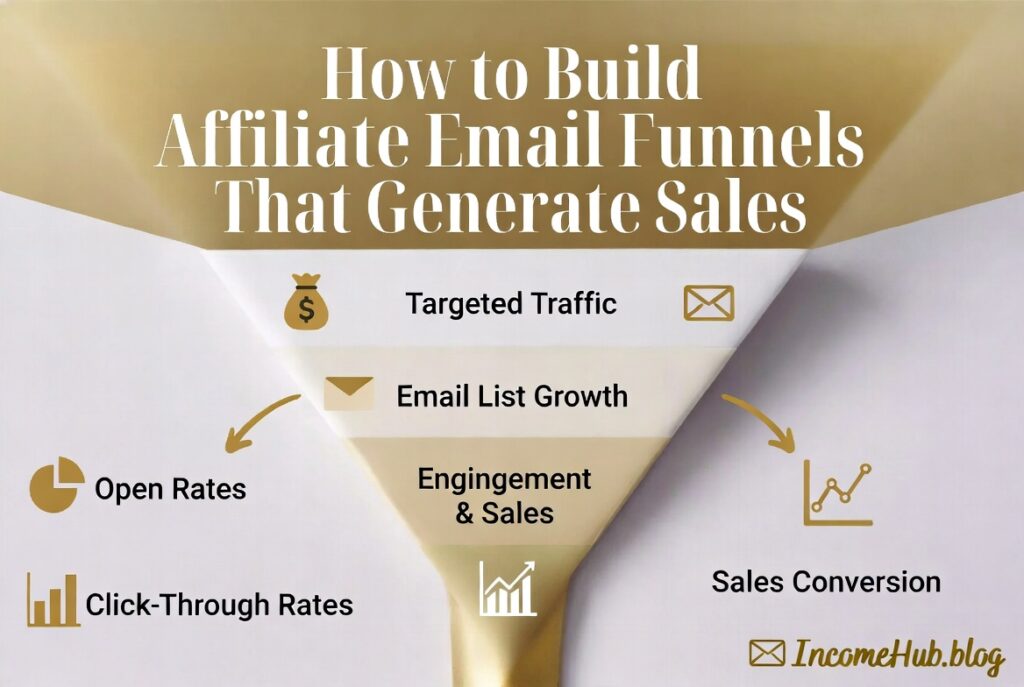
Open rate tells you whether your subject lines are working. Click rate on the affiliate link tells you whether the email content itself is persuasive. And the actual sales or signups attributed to the sequence (most affiliate networks let you tag links so you can isolate this) tell you whether the whole thing is worth the setup time. Review these numbers monthly for the first few months, then quarterly once the sequence is stable and converting consistently.
Segmentation: Sending the Right Email to the Right Reader
Treating your entire list as one audience is one of the fastest ways to tank engagement over time. Someone who downloaded a beginner checklist three days ago is in a completely different headspace than someone who’s opened every product comparison email you’ve sent for the past two months. Sending both groups the identical promotion ignores information you already have about where each person actually is.
Simple segmentation doesn’t require expensive tools. Tagging subscribers based on which lead magnet they signed up through, which links they’ve clicked, or how long they’ve been on the list gives you enough to send noticeably more relevant emails. A subscriber who’s clicked every budget-option link you’ve sent probably doesn’t need your premium-tier recommendation pushed as hard as someone who’s clicked the higher-end comparisons. Even this basic level of segmentation tends to lift click-through rates meaningfully compared to one-size-fits-all broadcasts.
Automation vs Broadcast: Using Both Correctly
Automated sequences (the welcome series new subscribers move through automatically) and broadcast emails (one-off sends to your whole list or a segment) serve different purposes, and conflating them is a common mistake. Automation should carry the weight of building trust and making your first few recommendations, since it runs the same way for every new subscriber and you can refine it once to improve results for everyone going forward.
Broadcasts are where timely material belongs: a tool just dropped a discount, a new product launched in your niche, a seasonal angle is relevant right now. Mixing timely broadcast content into your evergreen automated sequence usually backfires, since a “Black Friday deal” email feels strange to a new subscriber reading it in March. Keep the automated sequence evergreen and use broadcasts for anything time-sensitive, and review both separately when checking performance, since they tend to convert at different rates for different reasons.
Making Your Lead Magnet Specific Enough to Convert
Generic lead magnets like “free newsletter” or “weekly tips” rarely convert well anymore, because they don’t promise anything concrete enough to be worth a stranger’s email address. A narrow, specific offer (a comparison cheat sheet of the five tools you cover most, a checklist for choosing between two specific options, a short calculator) tends to convert visitors into subscribers at a noticeably higher rate, because the value is obvious and immediate rather than vague and ongoing.
The lead magnet doesn’t need to be elaborate. A single well-designed PDF summarizing information that already exists across several of your articles, packaged into one downloadable reference, often performs better than a longer guide that took far more time to create. Readers are trading their email for convenience and clarity, not necessarily for volume of new information.
Staying Compliant Without Overthinking It
Email marketing carries legal obligations that are easy to overlook when you’re focused on writing good copy. Every affiliate email needs a visible, working unsubscribe link, and in most jurisdictions a clear disclosure that links in the email may be affiliate links earning you a commission. Burying this in tiny footer text technically may not satisfy disclosure requirements depending on where your subscribers are located, so placing a brief, honest note near the relevant links is the safer approach.
Beyond the legal minimum, respecting your own list’s attention pays off in deliverability. Lists that get spammed with too many promotional sends tend to see rising unsubscribe and spam-complaint rates, which email providers track and can use to start filtering your future emails into spam folders even for engaged subscribers. Pacing promotional emails against genuinely useful, non-promotional ones tends to protect long-term list health far better than maximizing every single send for short-term clicks.
Frequently Asked Questions
How many subscribers do I need before this is worth setting up? Build the sequence as soon as you have any traffic at all. A five-email sequence converting at even 2 percent on a hundred subscribers a month adds up fast, and it keeps compounding as your list grows.
Can I put affiliate links directly in marketing emails? Yes, as long as you disclose the relationship clearly and comply with your email platform’s terms, most of which explicitly allow affiliate marketing as long as you’re not running cold outreach or purchased lists.
Should every email push a sale? No. A sequence that only ever pitches feels exhausting fast. Mixing genuine value, like a tip or a story, with your promotional emails keeps subscribers opening for longer.
How big does my list need to be before it’s worth the effort? Even a few hundred engaged subscribers can outperform a much larger but disengaged list, since email’s real advantage is being able to reach people directly rather than relying on raw size.
What email platform should I start with? For most beginners, a platform with straightforward automation and reasonable pricing at low subscriber counts, several of which are covered in our SaaS affiliate programs guide, is enough to run everything described here without needing to upgrade for months.
Once your funnel is converting subscribers reliably, the next lever to pull is improving conversion rate on the pages those emails point back to. Our guide to affiliate conversion rate optimization covers exactly that.