
Table of content:
- Commercial Intent Beats Search Volume Every Time
- Where the Sweet Spot Actually Sits
- Free Tools That Get You Most of the Way There
- When Paid Tools Earn Their Subscription
- Why Difficulty Scores Lie to Affiliate Marketers
- Mining Competitor Gaps
- Turning a Keyword List Into a Content Plan
- A Simple Repeatable Process
- Free vs Paid Keyword Tools: What's Worth Paying For
- Why Search Volume Numbers Often Lie
- Commercial Intent Modifiers That Find Hidden Opportunities
- Mining Competitor Gaps for Quick Wins
- Frequently Asked Questions
- Related Guides
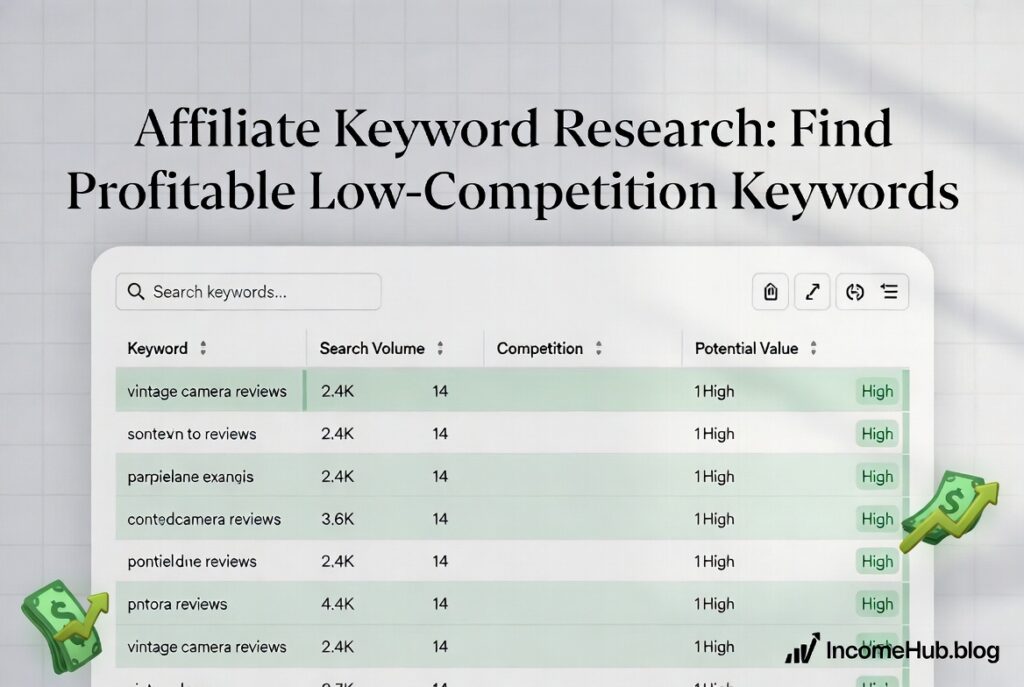
Generic keyword research tools weren’t built with affiliate sites in mind. They optimize for search volume and a difficulty score that’s calculated from backlinks and domain strength, neither of which tells you the thing you actually need to know: will someone searching this term click an affiliate link and buy something? A keyword with 50,000 monthly searches and a “low difficulty” score is worthless if every searcher just wants a free definition and has zero intent to spend money.
Commercial Intent Beats Search Volume Every Time
Look for the modifiers that signal someone is close to spending money: “best,” “review,” “vs,” “alternative,” “price,” “discount,” “worth it,” and phrases tied to a specific use case like “for beginners,” “for small business,” or “for [specific job].” A keyword like “best project management software for solo consultants” might only get 90 searches a month, but nearly every searcher is in active buying mode, which beats a 5,000-search informational keyword that converts almost nobody.
A simple gut check: would you, personally, click an affiliate link if you searched this exact phrase? If the honest answer is no, the keyword probably belongs in your awareness-stage content instead of your money pages.
Where the Sweet Spot Actually Sits
New affiliate sites almost always need to live in the bottom-left quadrant for the first year: lower search volume, low competition, but still carrying real commercial intent. Dozens of small wins in that quadrant compound into real traffic and real income while you slowly build the authority needed to compete for the bigger terms later.
Free Tools That Get You Most of the Way There
Google‘s autocomplete and “People also ask” boxes reveal real phrasing real searchers use, often surfacing long-tail variations you’d never have guessed. AnswerThePublic and AlsoAsked both visualize these question clusters in a format that’s easy to scan for content gaps. Google Trends helps you avoid building content around a keyword that’s quietly declining, which matters more in fast-moving categories like AI tools than in stable ones like accounting software.
When Paid Tools Earn Their Subscription
Free tools tell you what people search; paid tools like Ahrefs, Semrush, or Mangools tell you roughly how hard each term is to rank for and what specifically would be required to compete. Once you’re past the very early stage and trying to plan a whole content cluster at once, the time saved scanning a keyword list with real volume and difficulty data tends to justify the subscription cost within a month or two.
Why Difficulty Scores Lie to Affiliate Marketers
A keyword’s difficulty score is calculated from the backlink profile of pages currently ranking, but it says nothing about who those ranking pages actually are. If the top ten results are Forbes, NerdWallet, and a major retailer’s own product page, a “low difficulty” score is misleading, you’re not realistically outranking those domains anytime soon on raw content quality alone. Always manually check the actual top ten results for any keyword you’re considering, not just the number a tool assigns it.
Mining Competitor Gaps
Run a smaller, niche-relevant competitor’s URL through a content gap tool and look specifically for keywords they rank for on page two or three, not page one. Those are terms with proven demand where the existing competition is weak enough that a genuinely better, more thorough article has a real shot at outranking them within months rather than years.
Turning a Keyword List Into a Content Plan
A spreadsheet of five hundred keywords is useless until it’s grouped into clusters that map to actual pages. Group keywords by the specific product or category they’re about, decide which keyword each group’s primary page should target, and treat the rest as supporting subheadings or separate but linked articles rather than separate competing pages targeting nearly the same term. This clustering step is what connects keyword research to the broader plan covered in our affiliate content marketing strategy guide, and it’s also what keeps your internal linking, covered in our affiliate SEO guide, organized instead of chaotic.
A Simple Repeatable Process
Start with one seed keyword tied to a product or program you want to promote. Pull autocomplete and “people also ask” variations for that seed. Check actual search results for each variation to judge real competition, not just a tool’s score. Group the survivors into a cluster with one clear primary keyword. Repeat for your next product or program. This takes longer than dumping a seed list into a tool and exporting five hundred rows, but it produces a content plan you can actually execute with confidence.
Free vs Paid Keyword Tools: What’s Worth Paying For
Google’s own Keyword Planner is free but built for advertisers, so its volume buckets are often vague and its difficulty data is nonexistent, which makes it a weak standalone tool for affiliate research. Free alternatives like Google’s autocomplete, the “People also ask” boxes, and AnswerThePublic give you real phrasing people actually search, which is genuinely useful for finding long-tail variations, even without hard volume numbers attached.
Paid tools like Ahrefs, Semrush, and Mangools earn their subscription cost once you’re publishing regularly, mainly because of two features free tools don’t replicate well: accurate competitor gap analysis (seeing exactly which keywords a competing site ranks for that you don’t) and click-through-rate-adjusted traffic estimates that account for how much of a keyword’s searches actually result in clicks versus getting answered directly on the results page. If budget is tight, a single month of a paid tool used to do bulk research, exported into a spreadsheet, often delivers most of the value without an ongoing subscription.
Why Search Volume Numbers Often Lie
Every keyword tool gives you a single estimated monthly search volume, and beginners tend to treat that number as gospel. It isn’t. Volume estimates are modeled, not measured directly, and different tools can show wildly different numbers for the exact same keyword, sometimes by a factor of three or four. Worse, a keyword showing “1,000 searches a month” might represent ten different search intents bundled together, only one of which matches what you’re planning to write.
A more reliable approach treats volume as a rough directional signal rather than a precise figure, and weighs it alongside how clearly commercial the intent looks and how weak the current top-ranking pages are. A keyword with modest, even unreliable volume but obvious buying intent and weak competition will usually outearn a high-volume keyword stuffed with informational content and dominated by sites with far more authority than yours. Chasing the biggest number on the page is one of the most common ways beginners waste months writing content nobody can realistically rank for.
Commercial Intent Modifiers That Find Hidden Opportunities
Beyond the obvious “best,” “review,” and “vs” modifiers, a handful of less obvious phrases tend to surface keywords with strong buying intent and noticeably less competition, simply because fewer affiliates think to target them directly. Phrases like “alternative to,” “worth it,” “how much does X cost,” and “is X good for [specific use case]” all signal someone close to a purchase decision, often with far less content already competing for that exact phrasing than the more obvious “best X” searches.
Location and use-case specific modifiers work similarly well. “Best X for small business,” “best X for beginners,” and “best X under $50” each carve out a narrower, less contested slice of an otherwise crowded keyword, while still attracting searchers who are clearly ready to buy something in that category. Stacking several of these modifiers across a handful of core topics tends to produce a far longer list of realistic keyword opportunities than chasing the single highest-volume version of each topic.
Mining Competitor Gaps for Quick Wins
Looking at what a successful competing site ranks for, rather than starting keyword research from a blank page, is one of the highest-leverage research methods available. Most paid keyword tools include some version of a “content gap” or “competing domains” report that shows keywords a competitor ranks for that your own site doesn’t yet have content covering. This skips a lot of guesswork, since you’re working from keywords that have already proven to attract real search traffic for a site similar to yours.
The most useful gaps to chase first are usually keywords where the competitor ranks on page two or the bottom of page one, since that signals the keyword is winnable without years of accumulated authority, rather than keywords where they’re locked into the very top spot with a much older, more established page.
Frequently Asked Questions
How much search volume is “enough” for a new affiliate site? Even 20 to 100 monthly searches is worth targeting if commercial intent is high and competition is genuinely low; ten such pages can add up to meaningful income faster than chasing one 5,000-volume term you’ll never rank for.
Should I avoid keywords big sites already rank for? Not entirely, but be realistic about timelines. Plan to compete on those terms after you’ve built authority through easier wins, not as your very first published content.
How often should I redo keyword research? Revisit your core clusters every few months, since search behavior shifts, especially in fast-moving categories like software and AI tools where new comparison terms appear constantly.
Do I need a paid tool to get started? No. Free tools and manual research using autocomplete and “People also ask” sections are enough to find your first twenty to thirty article topics. A paid tool becomes worthwhile once you’re researching at scale or doing competitor gap analysis regularly.
What’s a realistic keyword difficulty to target as a new site? There’s no universal number since difficulty scores aren’t standardized across tools, but as a rough starting point, new sites usually have more success chasing long-tail, multi-word phrases with clear buying intent than short, single-word categories dominated by established players.
Once your keyword clusters are mapped, the next decision is which content format best matches each one. Our comparison articles blueprint is the natural next stop for anything shaped like an “X vs Y” or “best of” keyword.