

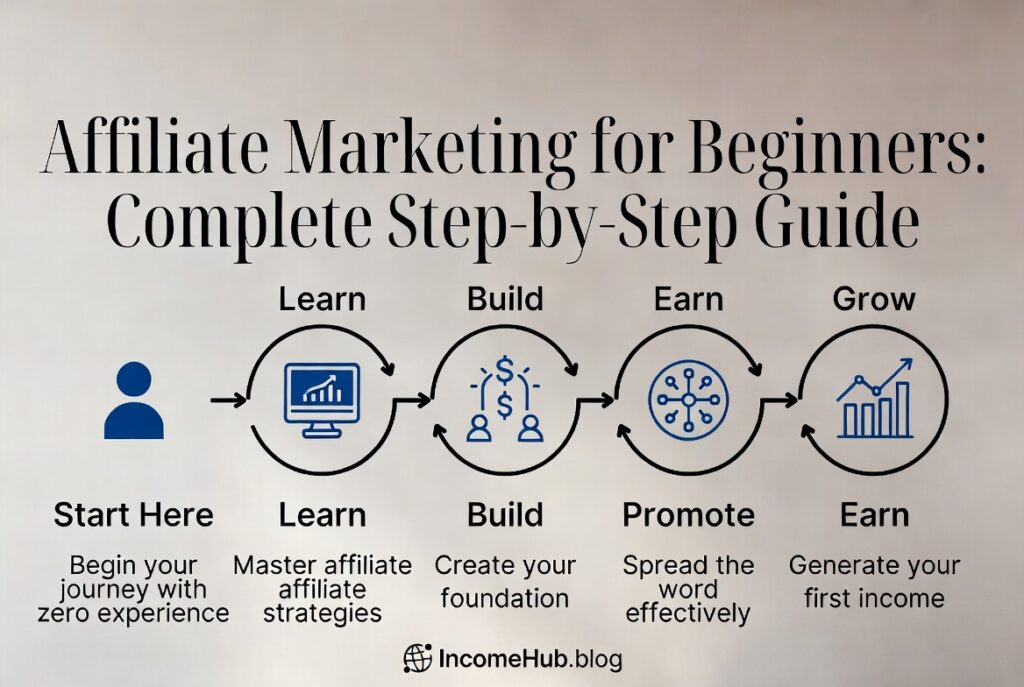
Table of content:
- What Affiliate Marketing Actually Is
- How the Money Actually Flows
- Step 1: Pick a Niche You Can Write About for Two Years
- Step 2: Choose the Platform That Matches How You Communicate
- Step 3: Join the Right Programs (Not the Most Programs)
- Step 4: Build a Site That Doesn't Get in the Way
- Step 5: Create Content That Actually Moves People to Click
- Step 6: Drive Traffic Without Burning Out
- Step 7: Track Everything and Fix What's Broken
- What Realistic Earnings Look Like
- The Trap Almost Every Beginner Falls Into
- What to Do in Your First Week
- Frequently Asked Questions
- Related Guides
Most people who start with affiliate marketing quit within the first three months, not because the model is broken, but because nobody told them what actually happens in those first months. You won’t make money in week one. You probably won’t make money in month one either. What you’re building, slowly and often invisibly, is a system: an audience, a set of pages, a reputation. Once that system is in place, commissions start showing up almost on their own.
This guide walks through that system from the very start, the way I’d explain it to a friend over coffee rather than the way it usually gets explained in courses that are trying to sell you something. By the end, you’ll know exactly what to do in your first week, your first month, and your first ninety days.
What Affiliate Marketing Actually Is
Affiliate marketing is a referral arrangement. A company pays you a cut of a sale (or sometimes a flat fee for a lead) because you sent them a customer who wouldn’t have found them otherwise. You get a unique tracking link, you share it somewhere people will see it, and when someone clicks that link and buys within a set window, you get paid.
That’s the whole mechanic. The hard part isn’t the mechanic, it’s getting people to click your link who are actually ready to buy. That’s a content and trust problem, not a technical one, and it’s why this guide spends more time on content and audience than on signing up for programs.
How the Money Actually Flows
It helps to see the chain end to end before you build any piece of it. Here’s the simplified version of what happens between you writing a sentence and money landing in your account.
Step 1: Pick a Niche You Can Write About for Two Years
The single biggest reason beginners stall is niche choice made for the wrong reasons. People pick “make money online” or “luxury watches” because the commissions look big on paper, then run out of things to say after twelve posts. Pick something you already know enough about that you could write fifty article ideas right now without googling a single one. Knowledge compounds into speed, and speed is what keeps you publishing during the unpaid months.
A useful filter: does the niche have products people pay a recurring fee for, or buy more than once? Software, hosting, courses, and subscription boxes tend to outperform one-time purchase niches over a full year, simply because the lifetime value per customer is higher. We cover this in detail in our guide to the best affiliate networks to join in 2026, which breaks down which niches pay the most per referral.
Step 2: Choose the Platform That Matches How You Communicate
You don’t need a blog. You need whichever format you can produce consistently. If writing comes naturally, a website built around search traffic is the most durable option because content keeps ranking and earning years after you publish it. If you’re better on camera, YouTube has a similar long-tail effect. If you’re a fast talker with strong opinions, a newsletter or a tight Twitter/X following can work too, though it usually needs to feed traffic back to a site eventually.
Most successful affiliates end up combining a website with at least one other channel, because a site gives you a home base that Google can index, while social and email give you direct access to an audience that doesn’t depend on an algorithm.
Step 3: Join the Right Programs (Not the Most Programs)
New affiliates tend to sign up for everything that accepts them, which scatters their links across a dozen low-converting offers. A better approach: pick two or three programs that match your niche tightly, and go deep on those before adding more. Amazon Associates is the easiest first program for almost any niche because approval is fast and the catalog is huge, but the commission rates are thin and the cookie only lasts 24 hours. If your content covers software, subscriptions, or recurring tools, you’ll likely earn more per reader through dedicated programs or networks, which we break down in our roundup of Amazon Associates alternatives that pay higher commissions.
Most networks (the platforms that host many merchant programs in one dashboard) require a working site with a handful of published posts before they approve you, so don’t wait for approval to start writing. Apply once you have five to ten solid articles live.
Step 4: Build a Site That Doesn’t Get in the Way
Your site’s job is to load fast, look credible, and make the affiliate link obvious without feeling like a trap. WordPress with a lightweight theme covers this for almost everyone starting out. Skip the page builder bloat, skip the fifteen plugins, and get an SSL certificate and a fast host before you publish anything. None of this needs to be fancy. Readers forgive plain design. They don’t forgive a page that takes six seconds to load on a phone.
Set up your category and tag structure before you have fifty posts, not after. Once you’ve decided on a content plan, our guide to affiliate SEO and ranking affiliate websites on Google goes deeper into the technical side of structuring a site that search engines trust.
Step 5: Create Content That Actually Moves People to Click
Three content types do almost all the heavy lifting in affiliate marketing: reviews, comparisons, and “best of” roundups. People reading these have already decided to spend money, they just need help deciding what to spend it on. That’s a very different reader than someone reading a general blog post out of curiosity, and your conversion rates will reflect that difference dramatically.
Write like you’ve actually used the thing, because readers can tell the difference between genuine experience and a rewritten spec sheet within a paragraph or two. If you haven’t used the product, say so honestly and base your review on verified user feedback, screenshots, and documented features instead of pretending otherwise. We go deep on this exact structure in how to create affiliate review articles that convert.
Step 6: Drive Traffic Without Burning Out
SEO is the slowest traffic source to start and the most durable one over time, which is exactly why most affiliates lean on it. Pages can take three to nine months to rank meaningfully, so the early months are about banking content while income is near zero. That’s normal, not a sign you’re doing it wrong.
While you wait on SEO, Pinterest, YouTube, and a small email list can bring in faster, if smaller, traffic. Pick one secondary channel and stick with it for at least ninety days before judging whether it works. Our guide to affiliate keyword research and finding low-competition keywords is the natural next step once you’re ready to plan content around what people are actually searching.
Step 7: Track Everything and Fix What’s Broken
Most beginners check their earnings dashboard obsessively but never check click-through rate, which is the number that actually tells you whether your content is working. A page with traffic but no clicks usually has a placement problem, not a traffic problem. Fixing button placement, adding a comparison table, or rewriting a weak call to action can double earnings on a page without adding a single new visitor.
What Realistic Earnings Look Like
Numbers vary wildly by niche, but a rough pattern shows up across most beginner case studies: close to nothing for the first three months, a few hundred dollars a month by month six if you’ve published consistently, and a meaningful side income (often $1,000 to $3,000 a month) somewhere around the one-year mark for sites that stayed consistent. Sites that focus on recurring-commission products tend to compound faster after that point because old referrals keep paying out monthly. Nobody hits these numbers by publishing five posts and waiting. The affiliates who get there are the ones who treated month four exactly like month one: showing up and publishing anyway.
The Trap Almost Every Beginner Falls Into
Here’s a pattern that shows up in nearly every beginner case study, including a lot of failed ones: someone publishes their first three articles, drops affiliate links into every paragraph, and then wonders why nobody clicks. The problem isn’t the links. It’s that the reader hasn’t decided to trust the site yet, and a stranger’s recommendation only works once trust exists.
Trust gets built in small, almost boring ways. A page that loads fast. An author bio that sounds like a real person rather than a content farm. Photos that look like they were actually taken by the writer instead of pulled from a press kit. None of these things directly make money, but they’re the reason a reader believes your recommendation enough to click through and buy. Skipping straight to “buy this” before any of that exists is why so many beginner sites get traffic without ever converting it.
A simple fix that works surprisingly well: write your first ten articles as if there were no affiliate links at all, focused purely on answering the reader’s question as completely as you can. Add the links in afterward. You’ll notice the writing reads less like a sales pitch and more like advice, and that shift alone tends to lift click-through rates once the links go in.
What to Do in Your First Week
If you want a concrete starting checklist rather than a vague sense of “get started,” here’s the order that wastes the least time. Day one: pick your niche using the filter from Step 1, and write down ten article titles you could publish without any additional research. Day two: register a domain and get hosting set up, keeping the WordPress install as plain as possible. Day three and four: write and publish your first two articles, neither of which needs an affiliate link yet. Day five: apply to your first one or two affiliate programs based on what those articles cover. Day six and seven: write two more articles and start mapping out the next twenty topics.
This isn’t the only valid order, but it front-loads the part beginners usually delay (publishing) and pushes back the part they usually rush (monetizing), which tends to produce better results than doing it the other way around.
Frequently Asked Questions
Do I need a website to start affiliate marketing? No, but it makes the business far more durable. Social accounts can disappear or get throttled overnight; a website you own keeps working.
How much money do I need to start? Realistically, very little. Hosting and a domain run about $5 to $15 a month, and most affiliate programs are free to join. The real investment is time.
Can I do affiliate marketing without showing my face? Yes. Written content, faceless YouTube formats, and Pinterest all work without you appearing on camera.
How long until I get my first commission? Most people who publish consistently see their first sale somewhere between week three and month three, often from an unexpected page rather than the one they thought would perform best.
Before you go further, it’s worth avoiding the traps that quietly sink most beginner affiliate sites. Our breakdown of 15 affiliate marketing mistakes that kill your revenue covers the errors that don’t look like mistakes until six months in, when you realize why the numbers never moved.